Showing posts with label medical mondays. Show all posts

Medical Mondays: Resources for the Basic Sciences (Year 1-2)

Monday, August 4, 2014


Welcome back! I totally didn't realize the Medical Monday link-up was on vacation for the summer but here I am anyway!  Today I'm sharing my must-have resources for your first two years of medical school! 

Because of our systems-based curriculum, I found that the books & resources I use typically carry over to each system. Our school provided many "required" textbooks on our iPads but unless the reading was mandatory, I rarely used them. Textbooks tend to be dense and provide way more information that you really need. You don't have time for all that! 

Below are the resources I found to be most helpful during my first year. I will continue to edit this list based on your suggestions!

Anatomy: 
For anatomy, we followed along with a dissector and also had a class textbook or two. When it comes to anatomy, the key is repetition. The best way to study is to grab a classmate or two and quiz each other in the lab. Don't just ask each other what something. Think, "What would go wrong if I injured this nerve?" "What would be injured if a patient experienced trauma here?" etc. Anticipate exam questions - chances are they will not be straight forward but rather higher level thinking questions.  
    • Netter's Flashcards
      • These are great for on-the-go anatomy quizzing. I used to carry mine around where ever I went so I had something to study at all times. They are just like the Netter's Atlas and contain an excellent amount of information beyond identification questions.
    • Netter's Atlas of Human Anatomy
      • Beautifully illustrated and very accurate with everything you need and many different views of the anatomy. It's a book of art!
    • Rohen Color Atlas of Anatomy
  • I actually preferred this book when I didn't want to head to the anatomy lab - it contains real photos of cadavers which is helpful because the anatomy is not colorful and pretty like in the Netter Atlas. I suggest starting with Netter's and then once you get more familiar with the material, start quizzing yourself with Rohen's.

Systems-Courses:
    • ***First Aid for the USMLE Step 1
      • If ever there was a Bible for medical school, this would be it. Step 1 is the go-to book for board prep. I received my copy for "free" by signing up for an AMA membership. While I'm not studying for boards quite yet, it's a great resource that sums up topics and organizes information easily. 
    • BRS Physiology
      • I haven't purchased this yet (will be doing so before classes start) but I've heard great things. It summarizes everything and give you the high points you need for board review.
    • Goljan Rapid Review of Pathology
      • Basically a book of outlines. It's nice to refer to if I have a quick question but it can be kind of dense for everyday study. I don't think I will use it much for board prep but it helps me organize my thoughts and compare/contrast similar conditions.
    • Rapid Interpretation of EKGs
      • I used this book for our Cardiology/Clinical Medicine courses when we were learning to read EKGs (go figure, right?). It's idiot proof - literally has fill-in-the-blanks and walks you through basic EKG readings. It helped me a lot and contributed to my love of EKG interpretation!
    • Lange Pharmacology Flashcards
      • Pharmacology is not my strength. Probably because it requires rote memorization and not very much understanding. These cards are great - I annotate them as necessary but they usually contain all the information I need and more. Making your own flashcards takes way too long - these are a great shortcut! 

Osteopathic Specific:
    • OMT Review
      • The Bible for every Osteopathic Medical student. Unfortunately there aren't very many quality resources when it comes to OMM but this one really has everything you need. I didn't find it to be "enough" for my OMM class exams but I've heard it is completely adequate for board review. It isn't fancy or as nice as any of the other books so don't be alarmed by the austere nature of this text...you will hug it and love it and sleep with it under your pillow.
Websites:
    • CV Physiology
      • For Cardiology/Cardio physio - my professor is the author of this website and the accompanying textbook. Very comprehensive and easy to understand. Lots of quiz questions, too!
    • Learn The Heart - EKG Practice
      • Another Cardio site - great for learning/practicing EKGs
    • Easy Auscultation 
      • Learn heart sounds - good for a beginner's understanding!
    • University of Michigan Anatomy 
      • I used this to quiz myself before exams when I was done in the lab. An awesome resource that was very similar to my Anatomy course exams (minus identifications - those are a little weak and hard to tell what is being tagged).
    • UpToDate
      • You will need free access through your school but as the name suggests, this is the perfect source for finding the most up-to-date, evidence-based medicine. Sorry but your professions won't be impressed if you reference Wikipedia in the middle of a small group session - go for a credible source like UpToDate.
    • The Cochrane Library
      • Another subscription service available through your school. This is a database of meta-analysis and other reviews of the most current medical research. 
Apps:
    • Firecracker
      • A new app I just dowloaded - you select topics you wish to review and it provides all sorts of questions to quiz your knowledge. You can keep track of how well you know each topic - keep reviewing until you know it!
    • Resuscitation
      • A fun GAME, especially for anyone interested in Emergency Medicine. A "patient" presents to the ED, you decide what kind of physical exam to conduct, what labs, treatments, imaging, etc. to do. Then you create your differential diagnosis and narrow down to your official diagnosis. A very comprehensive app - it's edutainment! 
    • Figure 1
      • Instagram for health professionals! It's a great way to interact with fellow professionals while learning about rare/cool/interesting diseases and patient presentations. 
Beyond spending your monopoly money on review books & resources, I strongly urge you to find a mentor that is ahead of you in school to pull information from - preferably a 2nd year who can help you excel at your specific school. Some schools will provide access to old exams, quizzes, and certain school-specific resources like note sets. Sadly, we don't have many of these resources at my school just yet so I rely heavily on blogs, Twitter friends, physician mentors, and strangers for my information (SDN, anyone?). 

I certainly do not think it's necessary to have all of these resources - you run the huge risk of overwhelming yourself and going broke. Pick a few things that work for YOU and go with it. In the end, you are being texted on a specific set of information and not how you acquired it. Studying is very individualized so don't feel pressure to do what everyone else is doing!

I will continue to update this list. What do you think? Any other resources I should add?

Calling all Health Professionals! {Dickies Scrub Review}

Monday, September 30, 2013

Over the summer I received the opportunity to check out the new line of Dickies Scrubs from a great online company called Uniformed Scrubs! (Disclaimer: I received this scrub top for free but all of the following comments are my honest opinions!) 

As you all know by now, I just started medical school two months ago but I previously worked as a Certified Nurse Assistant while I applied to school. Before that time, I had never bought scrubs so I wasn't really sure what brands would be comfortable or the best value. Needless to say, I have A LOT of less than stellar scrub sets. Finally, I bought a few Dickies nurse scrubs and I was really impressed with just how comfortable and well made they are - I could move around freely while still having the benefit of wearing a more feminine cut (I can't wear the unisex tops - my hips are too wide!)

Since I was already a Dickies scrub fan, when Uniformed Scrubs offered to let me try out their new line of scrub tops I was 100% in! The top they sent me is in the color "Wine" which I happened to already have in scrub bottoms! Even though they were two separate styles and collections, they match perfectly.


Currently, I'm in the anatomy lab three days a week for about 7-8 hours total so I NEED scrubs that are comfortable! This top is my favorite one to grab and throw on for a day in lab - it's soft, cut well for my curvy figure, and has a slight stretch! Plus, there are plenty of pockets which I'm sure will be super helpful for all you nurses & CNAs out there! 

After anatomy lab, I immediately wash my scrubs which means I've already washed this top a bunch of times and it still looks brand new (so do the scrub pants which I bought over a year ago!)


Overall, I'm really pleased with the quality and value of the Dickies brand - especially their new line of tops! Whether you are a student, nurse, physician, or other health care worker, you are guaranteed to look professional and well put together in Dickies scrubs. The colors are fun and not at all boring or muted. There is also a great selection of different styles and sizes for all body types! As a reference, this top is an XL but recently I moved down to a large top and large tall in bottoms.

The good news for you all - Uniformed Scrubs would like to give you all a discount - just use the coupon code "scrubfashion" for 15% off your next purchase! 


Go check out Uniformed Scrubs on their social media sites!

Medical Mondays: What is Osteopathic Medicine?

Sunday, September 1, 2013

Time for another installment of Medical Monday with two of my favorite bloggers! I'm so excited to have the opportunity to co-host this blog hop today (especially since I totally spaced and didn't write a post last month).

With classes starting, I thought it would be the perfect time to (briefly) explain the difference between osteopathic and allopathic medicine. 


If you had no idea there were two branches of medicine in this country, you aren't alone. I had almost no idea about allopathic vs. osteopathic until I was already applying to medical school. The funny part? You might already see a DO physician and not even know it. My primary care physician as well as my OB/Gyn are both DOs!

First of all, I attend an osteopathic medical school which means at the end of my four years I will (hopefully) have "D.O." or "Doctor of Osteopathic Medicine" (not osteopathy) after my name instead of "MD" or "Doctor of Medicine." So what's the difference? Not much.

Way back in the day a guy named Andrew Taylor Still set out to radically change the practice of medicine by rejecting the traditional methods in the 19th Century. Medicine was a lot different in these days. Popular practices included blood letting, dangerous drug use, and risky procedures that often did more harm than good. There was also not a lot of formal medical education - often an apprenticeship lasting a non-standard period of time with no official curriculum was the norm.

One area that sets osteopathic medicine apart from an MD is Osteopathic Manipulative Medicine (OMM). OMM can be described as manipulations of the musculoskeletal system to detect, treat, and cure disease or abnormalities of the body. He imagined the future of medicine to incorporate these manipulations while limiting surgical intervention and drug use. While DOs often reject this comparison, OMM can be compared to the skills a Chiropractor might use. One professor explained it to me this way: Chiropractors put you in normal alignment. DOs put you in YOUR normal alignment. It's all about finding your personal balance and achieving optimum health.

Another notable area of osteopathic medicine is an emphasis on holistic care of patients. A.T.Still emphasized the importance of considering the body as a whole unit - mind, body, and spirit - instead of seeing a person as a set of symptoms or a particular disease. Holistic healthcare and preventative medicine are both concepts that MDs accept and address so there is very little difference between the two now.

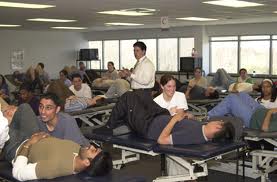
So what does this all mean? It means that in addition to all the classes MDs take, I also spend a few hours a week learning OMM in lecture and lab. (AKA getting REALLY close with your classmates quickly - hello palpation skills. We're already walking around in sports bras and shorts). Other than that, I learn EVERYTHING that MDs do. I have the opportunity to take the same board exams, apply for the same residencies, perform surgery, prescribe meds, etc. Nearly everything is that same - I just have the choice to use an additional tool for the treatment of my patients.

...and that's my mini spiel about Osteopathic Medicine! If you have ANY questions at all, please email me or leave a comment! I may turn your questions into a new post or two because it's impossible to explain the history succinctly. I love my school and I'm so proud to be studying osteopathic medicine. Now for the blog hop!


Are you confused if you qualify for the party?


If you have a pager interrupting your life... you DEFINITELY qualify!
Do you work in healthcare?
Doctor? Nurse? EMT? Chiropractor? Vet? Dentist? Therapist?
MA? NA? PA? DA?
Are you the spouse or SO of a healthcare worker/student?
Are you a nursing student? Medical student?
Intern? Resident? Fellow?

You get the picture, right? Come on, now... don't be shy! Let's keep growing and meeting new bloggers, so we can build a community of support and friendship, learn from one another, and share our stories.

LINK UP YOUR POST!

Here are the rules:
  1. Follow your co-hosts via Bloglovin, GFC (if you are Blogger), FB, email or Twitter.
  2. Link up you medical/med life blog. If your blog name does not clearly state how you fit in to the med/med life world, please write a little intro or link up a specific post which clearly demonstrates your connection.
  3. Visit at least 3 other link ups, comment, introduce yourself, and tell the your stopping by or following from MM!
  4. Help spread the word by using our button on your post or sidebar, tweet about Medical Monday, or spread the word on Facebook! The more the merrier for all of us.
Complete step one by following your co-hosts:
Want to be awesome?
Post our button on you post or sidebar and help spread the word:


Want to co-host next month? Shoot Emma an email at yourdoctorswife@gmail.com and be sure to write "Medical Monday Co-host Request" in the subject field.

Now, link up below and have fun! The link up is open through Friday, so be sure to come back during the week to check some great reads!

I Will Not Be a Geriatrician

Monday, July 1, 2013

Today I'm linking up for Medical Mondays with one of my favorite bloggers - Emma @ Your Doctor's Wife! She always has hilarious stories about life a physician's wife. I'm also linking up with Postcards from Rachel and Northern Belle Diaries for I <3 Bloglovin' so please go check out some new blogs if you have a chance.

If you've been following me for the last two months, you probably know I'm spending my gap year between college and medical school working as a Certified Nursing Assistant (CNA) or a glorified butt wiper/adult babysitter. I'm sorry, but that's just how it is.

I've learned a lot of things along the way, which you can read here and one of them is that I do not want to be a Geriatrician - an old people doctor. 

This post is highly appropriate since one of my friends who has always wanted to be a Geri doc just told me this weekend she no longer wants to do that either. I was shocked but thoroughly amused! (Sidenote: I'm making her guest post  soon about her first year of medical school so keep a look out for that!).

Just like when I talked about not wanting kids anytime soon (although all these weddings and cute babies on Instagram are making me giddy), I promise I actually do LOVE the elderly population. I love the stories they share about their families, growing up, getting married, their careers, etc. It's fascinating - especially because I've been blessed to know and work with so many veterans and members of the "Greatest Generation." 

With that said, I have the inescapable feeling that I'm simply not cut out for this sub-specialty of medicine. Here's why:

1. Elderly people have even less of a filter than I do.


I learned early on from my great-grandma that the older you get, the less time you waste filtering what you have to say (I can't wait to get old!). Granted all the women in my family already lack this trait so I thought it was just a woman thing for a while.  

Elderly people comment on everything; especially your appearance which can go one of two ways.  Something like, "You look like you've gained weight...in your butt especially," can really put a damper on things (and cause you to cry in a linen closet). On the flip side, an impromptu marriage proposal can totally make your day. Regardless you never know what comment is going to fly out of their mouths and unlike children, they aren't always cute when they say it.


2. Everyone is kicking the bucket.
Let's face it, no one is getting any younger. While this can be argued for all patients, geriatrics are knocking on death's door. One false move and an innocent fall turns into a week in the hospital and a fatal case of pneumonia. 

Here's the thing - I get attached easily. I've already lost a number of patients this year and death is hard - even when you know they are at peace and no longer suffering. While I know death will be present in any specialty I choose, OB-Gyn is looking really attractive right now - it's the business of creating life!


3. Too many medications.


Via
When I look at the amount of pills my patients take in a day, my throat closes up and I panic. How can you take all those medications and not feel like a zombie? I already take any vitamin or pill bigger than an aspirin with applesauce and tons of water - how do they do it?

Management of disease and the aging process usually includes medication for things like chronic pain, high blood pressure, diabetes, etc. Keeping side effects and drug interactions at bay is certainly an important role of a doctor but it's not something I'm too terribly excited by.

4. Too much of their day revolves around their bodily functions.
You haven't seen a grumpy old person until they can't have a bowel movement. Some of us judge a good or bad day by our interactions with others, the length of our work commute, or the quality of The Bachelorette and accompanying twitter discussion but the elderly have but one benchmark - bodily functions.

It seems like most old people have a heavily regimented bathroom routine and will not hesitate to describe in detail the actions or inactions within that routine. Up until recently, I denied that such bodily functions even existed for the female population so a job spent catering to these concerns isn't my cup of tea. (Might as well cross Gastro off my list, too).

5. They are like children, only adults.
People say that as we get older, we start to revert back to our childhood which seems to be true a lot of the time. We start to lose our ability to function independently and start to rely on others to perform many daily living activities - this is where I come in. Families get involved and start making personal decisions for their loved ones.

This is all well and good except elderly people aren't children - you have to respect their autonomy. Sure you can suggest changes to their diet or personal schedule but unlike children, they don't have to do what you say and they probably won't. What could be more frustrating? 


*********************************************************************************

Before I forget again, Saturday was my two month blogaversary! I can't believe how quickly June went and how crazy this adventure in blogging has been! Thank you all for your support and positivity!

Follow on Bloglovin

Medical Mondays: What I Wish I Would Have Known About Applying To Medical School

Monday, June 3, 2013


I've been waiting for this for a month - my first Medical Mondays link up!  So far, I haven't done a lot of blogging about medical school or college or being pre-med which is pretty strange since it's been a huge part of my life.  

I don't think I have many pre-meds or med students that read this but I'm confident that a lot of my experiences can be shared by those in graduate school or any professional school.  I would love to hear how your experiences compare and contrast!  We're all in this fun, educational boat together.

I'm also linking up with Postcards from Rachel & Northern Belle Diaries for I <3 Bloglovin' - because I do indeed love it.  It's wayyyy more convenient and user friendly than GFC - plus I can follow all my favorite medical blogs and news sources.  You can follow me, too!

Follow on Bloglovin

Now for the purpose of this post. There is A LOT I wish I would’ve known before I decided to apply to medical school the first time (I was a reapplicant this year).  Even though I've wanted to be a physician for most of my life, I didn't feel adequately prepared for the huge task of applying.  

It's really easy to lose sight of your goals when they seem so far off.  Eventually one day you wake up and realize it’s finally time to start submitting applications.  Here are the top 5 things I wish I would have known as a high school and college student!

1. Save Your Money
It's all about the $$$. Applying to medical school is e-x-p-e-n-s-i-v-e.  As if your college tuition wasn’t bad enough, time to tack on another couple thousand dollars for the MCAT, application fees, interviews, and deposits. 

People will tell you it’s all “a drop in the bucket” compared to the cost of attending med school but what they really mean to say is “there is no justifiable reason for this and it sucks.”  Bottom line, accept the fact that you will need to save your money, have super cool (or rich) parents to help you out, or get some credit cards. 

Via
2. Keep Your Eye On the Prize
My biggest problem was that applying to med school crept up on me.  One minute I was a freshman taking Intro Chemistry and the next I was a junior studying for the MCAT (while working & taking a full course load - bad idea!).  

If you have a bad semester, it’s easy to think, “Oh...I’ll do better next semester." or "Next semester I’m totally getting a 4.0.”  Guess how many times I said that compared to how many times it happened? 

You NEED to put the work in each and every semester even if you are just starting out at college.  College is a huge adjustment especially if you are like most pre-meds and didn't really have to study much in high school. One semester isn’t going to wreck your chances but eventually that attitude catches up with you.  


Via
3. Hurry Up and Wait
Start working on your applications as soon as the new application becomes available in May.  You won’t be able to submit until early June but you should have everything ready to go so you can submit right away.  

There is some lag time between app submission and release to the schools but by submitting as early as possible, you increase your odds of being some of the first applications the schools see.  This can only work to your advantage since most schools are on rolling admissions.  Many qualified applicants have been rejected just because they submitted way too late (think Oct/Nov).


I actually submitted pretty early in the process - around mid-June.  I was verified by the end of June and started getting secondaries in July.  What I didn't anticipate was all the waiting after my secondary apps were submitted.

Like all good things in life, you are going to spend the majority of your time waiting.  You will have all your applications ready to go, proofread, and sealed with hearts and kisses...then you will submit and often hear crickets.  

In this situation, you should toe the line between being enthusiastic and being a PITA.  Call admissions and check on your application status - this is something I should have done more often.  Make sure all your materials are submitted but also realize that the office staff has a ton of applications to deal with.  Be patient but be proactive.  Most of all, keep yourself busy.

Via
4. Be Realistic (Apply Broadly)
This was my second biggest problem applying the first time.  I chose schools I had no business applying to just because I wanted to be close to home. More than likely, you will have to move at some point in your medical education.  

You should apply to a variety of schools - reach schools, safety schools, and schools you have a reasonable chance of getting into. Purchase the MSAR for MD schools!  It will save your life.  I wish there was a better equivalent for DO schools but because there are significantly few schools of this kind, you should be able to find admission stats a little easier.

Only about 52% of applicants get accepted to medical school each year.  Maximize your chances by applying to a good selection of schools without sacrificing the quality of your secondary applications. You need to be able to write several quality essays within two weeks or less of receiving the secondary app for each school.  

5. Know Thy Self
Before you can start writing your personal statement and preparing for your interviews, you need to have a good grasp of who you are as a person and what makes you tick. Take a personality test or two, talk to your family and friends, chat with professors, volunteer/work in a clinical setting, and do some journaling - figure out who you are and if you truly want to go into medicine.

Believe it or not it was really hard for me to talk about myself constantly, let alone do so in about 15 different essays.  (For whatever reason, it was much easier in interviews.) I answered everything from why medicine, to strengths and weaknesses, to describe your interests in XYZ. 

Don't discount the importance of the personal statement and essays. You never know who is going to read them so make sure they really convey who you are and why you should be a future physician at that school.

Via
I could go on and on about all the things I wish I would've known or things that I knew but didn't prepare for.  The biggest piece of advice I have is to realize that medical school admission is a game. You have to do everything in your power to tip the odds in your favor and put your best foot forward.